
When people ask for the “safest car” against hijacking, they usually mean one of two things. Either they want a vehicle criminals are less likely to target, or they want a vehicle that gives them the best chance of surviving an attempted hijacking. In South Africa, the honest answer is that safety is rarely about a single model badge. It is about layers: where you drive, how predictable your routines are, what security technology your vehicle has, and whether the vehicle can physically protect you when things go wrong.
Recent South African crime statistics paint a clear picture of why this matters. For the January to March 2025 quarter alone, SAPS recorded 4,533 carjackings, which works out to roughly 50 hijackings a day. Even if trends rise and fall year to year, hijacking remains a day to day reality in many areas.
So what should you look for if your goal is to be safer on the road?
- A “safe” car is often one criminals do not want
It is uncomfortable, but true: criminals frequently target vehicles that are common, easy to move, easy to strip for parts, or known to be in demand. Multiple South African reports regularly highlight popular bakkies and high volume hatchbacks among the most targeted categories.
That does not mean you must avoid popular vehicles at all costs, but it does mean you should understand that “normal” can sometimes be high risk. If you drive a vehicle that is frequently targeted, you need stronger layers of prevention and recovery, such as tracking, defensive planning, and physical protection.
A practical approach is to ask two questions before you buy:
- Is this model commonly stolen or hijacked in my province or commuting area?
- If it is, can I add enough security layers to make it a harder target than the next car?
- Choose vehicles with strong factory security and anti theft tech
Modern vehicle security is not just about an alarm. It is about making forced entry, ignition defeat and fast getaways more difficult.
Look for features like:
- Factory fitted immobilisers and encrypted key systems
- Double locking and anti tamper door systems
- Alarm systems with interior monitoring
- Automatic door locking behaviour that cannot easily be overridden
- Telematics and connected services that can assist with location tracking and emergency response
A major point often missed is that technology is only helpful if it is configured correctly and used consistently. Keyless entry convenience features can be excellent, but they need extra care around signal interception and relay attack risk. If your vehicle offers keyless access, consider adding a signal blocking pouch for home and office use and ask your security provider what additional measures suit your model and parking situation.
- Prioritise driver assistance features that help you avoid vulnerable moments
Hijackings often happen at the exact moments when you are most restricted: slowing down, stopping, reversing, or searching for parking. Driver assistance features cannot stop criminals, but they can reduce exposure by improving your awareness and helping you manoeuvre more confidently.
Features worth prioritising include:
- 360 degree cameras and parking sensors, which reduce the time you spend distracted
- Blind spot monitoring, especially when changing lanes to create space
- Rear cross traffic alert, helpful when reversing out of a driveway or parking bay
- Good headlights and adaptive lighting where available, for early morning or evening travel
South African motoring sources increasingly highlight how advanced driver assistance systems are becoming more common in local models and how these features contribute to everyday road safety.
These systems are not a substitute for alert driving, but they do reduce cognitive load, which matters when you are travelling through high pressure nodes such as mall entrances, off ramps, petrol stations and residential gates.
- Look for vehicles with proven crash protection and strong safety ratings
Not all “safety” is criminal safety. The reality of South African roads includes serious accident risk too, and a vehicle with excellent occupant protection is part of an overall safety strategy.
If you want a shortlist of vehicles that are well regarded for modern safety equipment, look for models with strong Euro NCAP performance and standard fitment of systems like autonomous emergency braking and pedestrian detection. A South African motoring article on safer options for 2025 points to examples such as the Volkswagen T-Cross for strong safety assists, and the Mercedes-Benz C-Class for robust occupant protection alongside driver assist technologies.
These features are mainly designed for collision avoidance and crash survivability, but the broader point is important: a well engineered vehicle tends to be better at protecting occupants across multiple types of risk.
- The only true “anti hijacking” vehicle feature is physical protection
If your question is specifically about surviving an attempted hijacking, especially one involving handguns, then security technology and safety ratings only go so far.
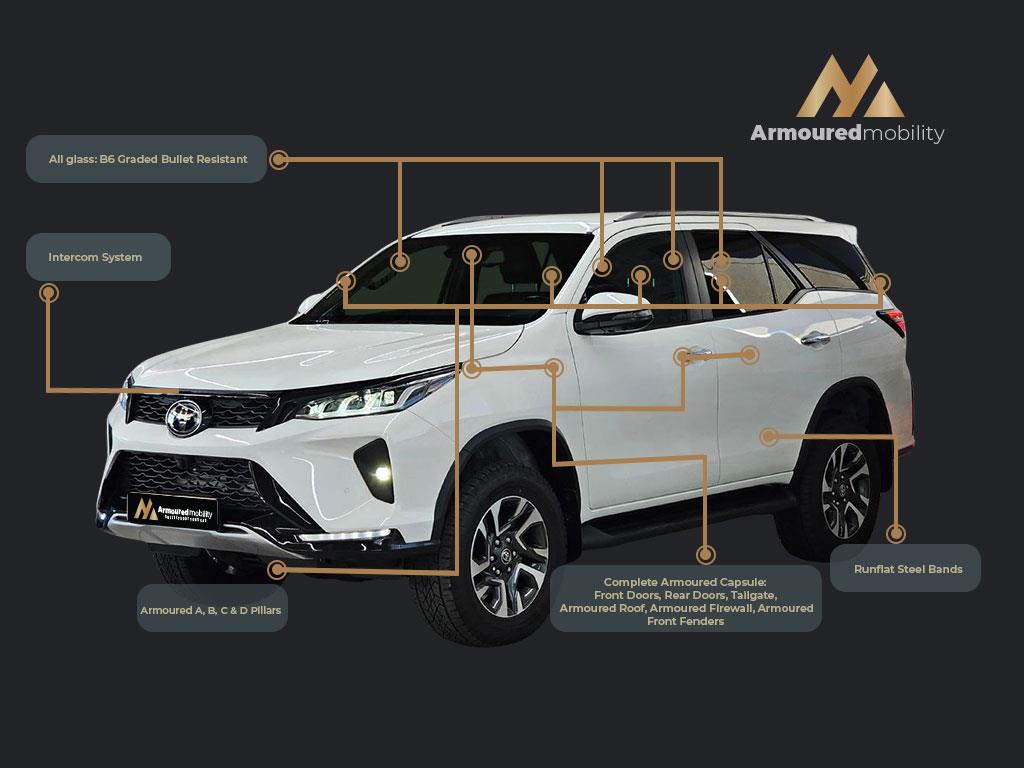
A standard vehicle door and side glass offer little resistance. If criminals decide to use violence quickly, the cabin becomes vulnerable within seconds. This is where armouring changes the conversation, because it introduces a physical barrier.
For many civilian clients, B4 protection is often considered the most practical level, because it is designed around the threats motorists are most likely to face in everyday hijacking scenarios. Armoured Mobility notes that B4 protection provides protection against almost all handguns, including 9mm, .40, .45 and .357, and is positioned as sufficient for hijackings and smash and grab attempts, with glass designed to help protect against fragmentation.
That does not make an armoured vehicle “invincible”, but it does buy time. Time to accelerate away, to reverse out, to reach a safe area, or to avoid forced entry. In real life, those seconds are often the difference between a close call and something far worse.
- A sensible “safest against hijacking” checklist
If you want to make the most practical decision possible, use this layered checklist rather than chasing a single model name.
Lower your risk of being targeted
- Avoid predictable routines when possible
- Be cautious around known congestion points and choke points
- Understand whether your model is commonly targeted in your region
Reduce your vulnerability in the moment
- Choose vehicles with strong visibility and driver assist aids
- Make sure locks, alarms and anti theft systems are active and correctly set
- Add tracking and recovery as a non negotiable layer
Increase survivability if an attempt happens
- Consider B4 armouring if your daily travel includes high exposure routes or frequent stops in vulnerable areas
The bottom line
In South Africa, the “safest car against hijacking” is rarely just the one with the best brochure. It is the one that is hardest to target, hardest to access, and most likely to protect you long enough to get away.
If you drive often, commute through high pressure nodes, transport family members, or simply want to reduce exposure, start by choosing a vehicle with strong factory security, modern driver assistance features, and proven occupant protection. Then decide whether your lifestyle and routes justify stepping up to physical protection such as B4 armouring, which is specifically designed around common civilian threats.