
Gqeberha has always had a distinct rhythm. It is big enough to offer serious business opportunity, education, healthcare and lifestyle, yet still carries the feel of a coastal city where families build long term roots. People commute between suburbs, business districts, industrial zones and the beachfront daily, often without thinking twice about the route.
That sense of familiarity is precisely why the recent shift in crime patterns has felt so unsettling. More residents and business owners are reporting heightened concern about road safety, particularly around vehicle related crime. Hijackings, smash and grab incidents and armed intimidation are not only stories from Gauteng or the largest metros. They are increasingly part of the security conversation in the Eastern Cape as well, including in and around Gqeberha.
For many people, the question has changed from “Would I ever need an armoured vehicle?” to “At what point does it become the responsible choice?”
Why Gqeberha’s road environment creates exposure
Like most South African cities, Gqeberha has predictable pressure points. There are areas where traffic slows, where vehicles are forced to stop, and where motorists have limited space to manoeuvre. Intersections, on and off ramps, parking entrances and congested routes around shopping nodes are natural pinch points.
The risks are not limited to one area. Drivers move between the beachfront and Summerstrand, through Walmer and Newton Park, towards the CBD and industrial zones, or out along key routes such as the N2 and R75 linking to Kariega and the broader region. Many people also travel regularly to and from Coega and the IDZ, where shift patterns can mean early morning or late night driving.
What increases vulnerability is not only where you drive, but when and how. Low light, quiet stretches of road, and moments of distraction such as checking directions or taking a call can turn an ordinary journey into a high risk encounter. Load shedding has also contributed to darker streets and less predictable lighting, which can affect visibility and response time.
When risk is tied to routine, prevention becomes far more important than reaction.
The reality of vehicle related crime
Most motorists do not consider themselves “targets”. They are parents on the school run, professionals heading to meetings, entrepreneurs moving between sites, or couples going for dinner. Yet vehicle based crime is often opportunistic. Criminals look for the easiest moment, not necessarily the most famous person.
This is why incidents frequently happen at traffic lights, at driveway entrances, or as vehicles slow to turn. They happen quickly and with intimidation, often involving handguns. The intention is to overwhelm the driver before they can react.
In these situations, even excellent awareness and defensive driving habits may not be enough. If you are boxed in by traffic, stopped at an intersection, or faced with a sudden approach at close range, your options narrow dramatically.
An armoured vehicle does not remove risk, but it changes the balance. It provides a physical barrier between you and the threat and buys time when seconds matter.
Why armouring is no longer seen as extreme
The old idea of an armoured vehicle is usually something bulky, obvious and designed for a very specific kind of client. Modern armouring is different. It is engineered to fit into normal daily life.
Discreet armouring keeps the vehicle looking like a standard premium SUV, sedan or bakkie. Interior comfort remains intact. The vehicle can be used for commuting, shopping, school runs and business travel without drawing attention. That discretion matters in Gqeberha, where many people want protection that does not change how they live or how they are perceived.
Importantly, modern protection levels can be selected according to realistic risk rather than worst case scenarios. For many private clients, B4 level protection is often the sensible middle ground because it is designed around the most common civilian threats, particularly handgun attacks. It is also more practical for daily use than heavier protection levels, which can add significant weight and alter vehicle dynamics.
This ability to match protection to everyday risk is one of the main reasons armouring is becoming more common across a wider range of South Africans.
Who in Gqeberha is considering armoured vehicles
The profile of armoured vehicle clients has broadened significantly, and Gqeberha is no exception.
Families are increasingly considering armouring because children spend so much time in the car. A school run is not a rare trip. It is a daily routine, often happening in predictable time windows and sometimes in traffic.
Business owners and senior managers are also reassessing road security. Many travel with laptops, sensitive documents, or valuable equipment. Others move between offices, warehouses, suppliers and meetings across the city and surrounding region. The more you travel, the greater your exposure, even if your lifestyle is otherwise low profile.
Professionals in public facing roles, such as those in sales, property, legal work or consulting, can also be more visible than they realise. Regular travel patterns and repeated visits to certain nodes create predictability. In a climate of increased opportunistic crime, predictability can be a weakness.
An armoured vehicle offers a way to reduce this vulnerability without changing your schedule, your routes, or your independence.
Why the psychological benefit matters as much as the physical one
It is easy to talk about armour in terms of steel, glass and protection ratings, but the biggest day to day benefit is often peace of mind.
When drivers feel vulnerable, they drive differently. They become tense at intersections. They avoid necessary trips at certain times. They become distracted by scanning for threats rather than focusing on the road.
A properly armoured vehicle changes that experience. It supports calm decision making. It gives drivers confidence that if something happens, they have a better chance of protecting themselves and their passengers. That confidence is not bravado. It is stability.
For many people, especially parents, that feeling is what makes armouring worth considering long before a personal incident occurs.
A sensible part of a broader security plan
Armouring should never be viewed as a standalone solution. The smartest approach is layered security.
Good habits still matter. Keeping doors locked, leaving space in traffic where possible, avoiding unnecessary stops in isolated areas, staying alert near mall entrances and petrol stations, and planning routes with awareness all reduce risk.
Armouring strengthens these habits. It provides a buffer when circumstances are not ideal, when traffic traps you, or when an encounter escalates faster than expected.
In a city where people need to move, to work, to attend school activities and to live a normal life, that added buffer can be decisive.
A subtle next step for Gqeberha motorists
If you live or work in Gqeberha and you have noticed the growing concern around vehicle related crime, it may be time to look at proactive options rather than hoping your routines remain untouched.
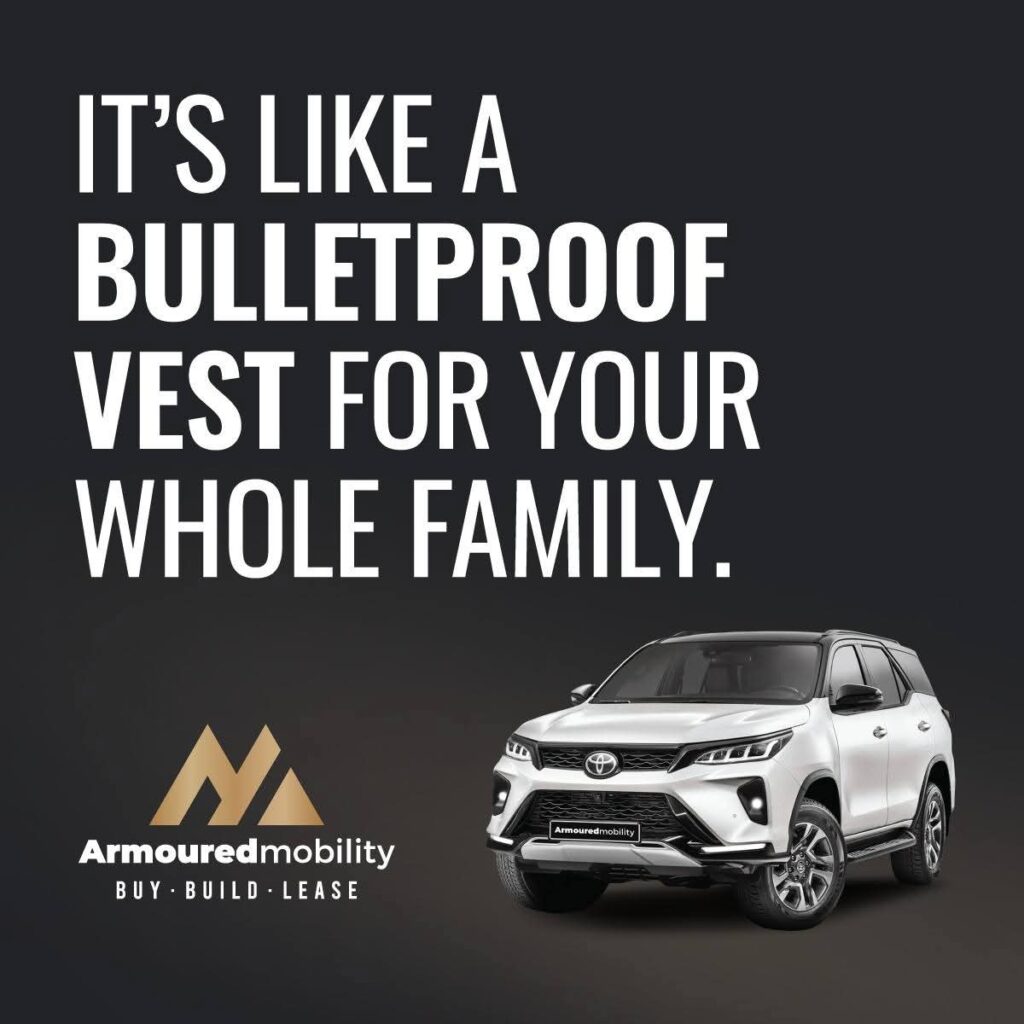
Armoured Mobility can advise on discreet armouring solutions suited to everyday use, including practical protection levels such as B4 for civilian threats. A short conversation about your routes, driving times and typical passengers can help you understand what is appropriate, without overcomplicating the decision.
Sometimes the most responsible security upgrade is the one that quietly protects you while allowing life to carry on as normal.